
The Swarm: What Starling Murmurations Teach Us About Leadership
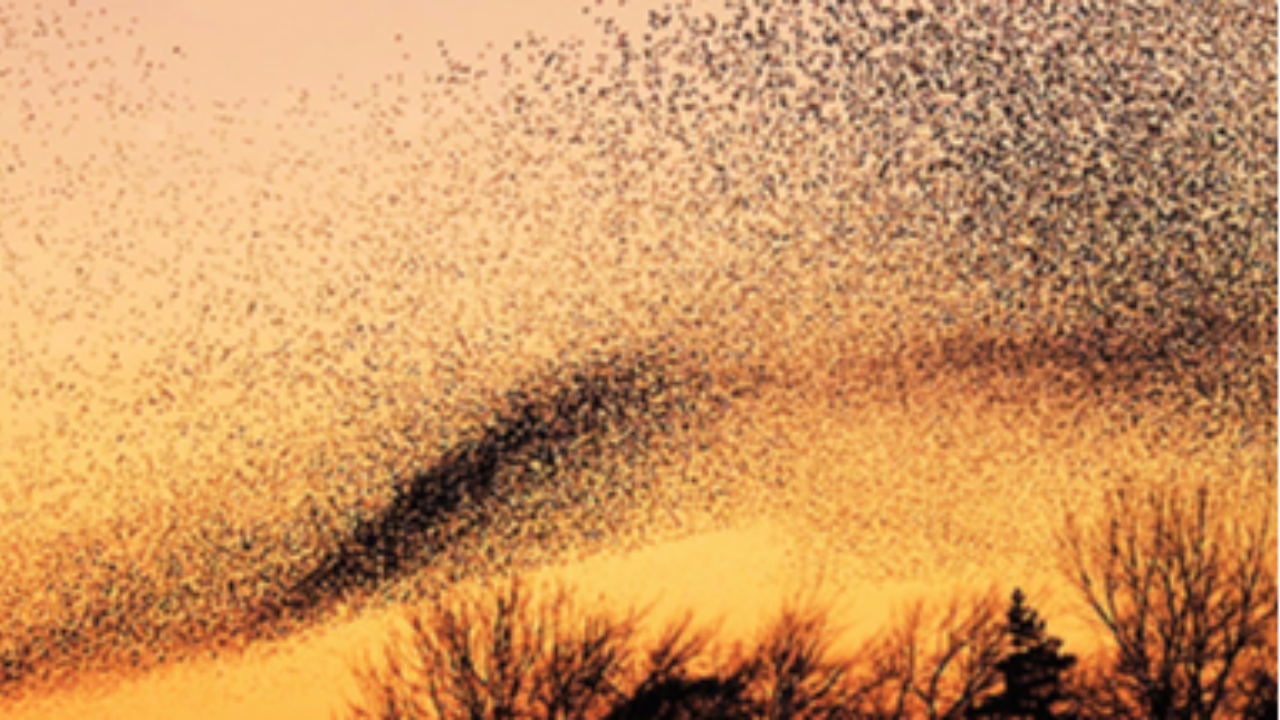
So I know it's still summer, and we (me) are not even close to thinking about fall. But an occurrence that happens in fall always comes as a useful reminder when I am working with teams on building their collective co-creation.
Every fall evening across the world, thousands of starlings gather in the sky to perform one of nature’s most amazing and often confusing phenomena: the murmuration.
Without a SINGLE leader giving commands or a map/blueprint guiding their flight, tens of thousands of birds shift, twist, and ripple through the air as a seamless, unified organism. They react to threats in milliseconds and adapt to unpredictable environments in real time. What a significant feat!
For leaders who want to build adaptable and agile teams, starling murmurations offer a class in emergent intelligence and, in particular, decentralized coordination.
This is why nature is our best teacher, helping us to build resilient systems and high-performing organizations.
- Local Interactions Drive Global Alignment
When you watch a murmuration, it looks like a synchronized dance. But in reality, scientists at the University of Rome found that no bird is watching the whole flock. Instead, each starling pays attention to only 6 or 7 nearest neighbors.
The Takeaway:
- In Business: Micro-alignments outweigh top-down micromanagement. Teams don't need a CEO directing every move; they need clear interfaces and strong alignment with their immediate partners.
- Focus instead on high clarity between immediate dependencies rather than trying to centralize control over the entire ecosystem.
- Simple Rules Lead to Complex Intelligence
I have always wondered, how do starlings avoid crashing into each other while creating such breathtaking patterns? They follow three basic principles (this is FASCINATING- (originally formulated by computer scientist Craig Reynolds in his Boids simulation):
- Separation: Avoid crowding local flockmates.
- Alignment: Steer toward the average heading of local flockmates.
- Cohesion: Move toward the average position of local flockmates.
Out of these three simple rules emerges swarm intelligence—a complex, highly adaptive system capable of evading predators instantly.
The Takeaway:
When organizations grow overly complex, agility often falls apart. Standardize a few core, non-negotiable principles across your team (e.g., prioritization, quality standards, clear ownership, etc.) and allow complex, innovative solutions to emerge organically.
- Scale Without Friction
This one blows me away.
Murmurations possess a remarkable property called topological distance. Whether a flock contains 100 birds or 100,000 birds, the information density and speed of communication remain constant. A change in direction by a bird on the far edge propagates through thousands of birds at speeds exceeding 20–40 meters per second. How can this be?
The Takeaway:
- Decouple to Scale: Scaling shouldn't slow you down! If adding people and process creates exponential communication overhead, your operational structure needs a redesign.
- Rapid Signal Propagation: Fast feedback loops—whether automated test suites or transparent incident reporting—allow large teams to pivot as fast as small ones. This one creates lasting impact.
- Resilience Through Redundancy
If a hawk strikes a starling murmuration, the flock splits into sub-flocks, wraps around the predator, and instantly merges back together. There is no "single point of failure." Losing one bird or one group does not compromise the structural integrity of the flock.
The Takeaway:
Building anti-fragile systems requires embracing failure and fault tolerance. Whether designing how to integrate innovation or improving your cross-functional team structures, build systems that naturally heal, reroute, and adapt when unexpected shocks occur.
Final Thoughts
The magic of the starling murmuration isn't that every bird knows what the flock will do next—it's that every bird knows how to respond to its immediate surroundings in service of a shared trajectory.
As we build the future of leaders and teams, the lesson is clear: stop trying to control the flock. Focus on setting clear local parameters, empowering individual nodes, and letting collective intelligence take flight.